Showing posts with label Agile Adoption. Show all posts

Sunday, December 14, 2014

Tragedies of Performance Evaluation of Software People

I'm constantly having conflicts with managers who insist on backward methods of performance evaluation for agile teams. It is one of the miseries of software teams, because in most cases, such methods demotivate individuals and undermine team values. The issue is serious to the extent that Professor Edward Lawler wrote a recent post in Forbes magazine titled: Eliminating Performance Appraisals. In this post, prof. Edward questions whether organizations should stop doing performance appraisals altogether, because they “do more damage than good”, and “when poorly done, they create a multitude of problems”!
I felt I have a moral obligation to write something in this regard. My contribution in this post is a collection of resources and an attempt to structure the topic into three high level subtitles:
  1. What's evil about performance appraisals
  2. Should smarter people be rewarded more money (as a means of motivation)?
  3. Using process data for the sake of individual performance
If you are a smart person suffering from a performance evaluation scheme from the middle ages, send your HR manager this post, and let him read the resources mentioned below. May be (I'm not sure) it may help.

1. What's evil about performance appraisals


First, this is an article: Should I Rank My Employees? from the Wall Street Journal. It mentions the following interesting survey:
"Stanford professors Jeffrey Pfeffer and Robert Sutton are among the most fervent critics. They cited a survey of more than 200 human resources professionals from companies employing more than 2,500 people that found that even the more than half the companies used forced ranking, the respondents 'reported that forced ranking resulted in lower productivity, inequity and skepticism, negative effects on employee engagement, reduced collaboration, and damage to morale and mistrust in leadership.' … "
Another blog by the famous software engineering management author: Esther Derby titled: Should a ScrumMaster (or any coach) Give Performance Appraisals? In this blog, Esther asks how would it be good while "psychologists know that 80 percent of people believe their performance is above average"

The topic of performance appraisal are very controversial to the extent that one of the so famous books in management in the last years is called: "Abolishing Performance Appraisals: Why They Backfire and What to Do Instead"

2. Should smarter people be rewarded more money (as a means of motivation)?


We need to change our believes that a merit system will not work unless it ranks employees into classes and every class is motivated by some more money.

This is a must-see master piece by RSA Animate: Drive: The surprising truth about what motivates us:

In this short animation, they attack very strongly the idea about motivation using financial incentives when it involves cognitive and knowledge work. At minute 1:50 till 4:15, this animation sites the results of a study done by three top universities in Engineering and Technology: MIT, University of Chicago, and Carnegie Mellon university:
"As long as the task involve only mechanical skill, bonuses worked as expected (higher pay = better performance). But, once the task called for rudimentary [basic or simple] cognitive skill, a larger reward led to poorer performance!"
Also, one of the most important books in software engineering history is Rapid Software Development: Taming Wild Software Schedules by Steve McConnell. This book was named the best Software engineering book in the year by Software Development magazine's Jolt Award. Please refer to this book to understand what motivates Software engineers. Chapter 11: Motivation is the best reference I read about motivating software engineers. In page 262, you'll find this quote: 
"At least two-dozen studies over the last 30 years have shown conclusively that people who expect to receive a reward for doing their jobs successfully don't perform as well as those who expect no reward at all (Kohn 1993). The work itself is the greatest motivator, and the more a manager stresses an external reward, the less interested the developer becomes in the work itself, and the more potential motivation is lost."
The author makes a very clear alarm that incentives has many forms which are non-monetary like:
  • Dinners with company executives
  • Vacation-time bonuses
  • Gifts of appreciation (theater tickets or dinners for two)
  • Sincere praise directed at a specific accomplishment
  • Team T-shirts, polo shirts, rugby shirts, watches, pins, mugs, posters,
  • Humorous or serious awards in the form of plaques, certificates, trophies, and the like
  • Special events to celebrate significant accomplishments; depending on your team's preferences, and event might be a dinner at a favorite restaurant, a show, a trip, a ski day, or a dinner at the boss's house (or, for maximum effect, the boss's boss's house)
  • Exceptions to company policies for the team, such as casual-dress Friday, a Ping-Pong table in your team's section of the building, free soda pop in the team refrigerator, and so on
  • Special courses (outside the local area)
  • Sponsorship at conferences that the organization would not ordinarily sponsor
  • Grade-level promotions
You can download this book from this location.
One more article called One More Time: How Do You Motivate Employees?, which sold more than a million reprints making it the most popular article in the history of the Harvard Business Review. In this diagram, notice the particular position of the salary and it's weight as a demotivator rather than a motivator. 
Motivators and demotivators - Notice that salary (money) is not among the motivators, but rather a demotivator in case salary is not sufficient
Actually, what this diagram tells us is the same exact phrase mentioned in the RSA movie above at minute 4:50:
"If you don't pay enough, people won't be motivated. Pay people enough to take the issue of money off the table"

3. Using process data for the sake of individual performance


Forcing managers to use process data, like feature estimates, number of bugs, reported actual hours, etc. to evaluate team members will blow up the process metrics themselves. This, in turn, has a drastic effect on the process itself, making the team process-blind (not being able to improve the process based on process metrics) Being process-blind is the direct result of exploiting process metrics and reuse them as Targets, and as per Goodhart's law: "When a measure becomes a target, it ceases to be a good measure."
Why this happens? To understand the dynamics, let's recall the general rule put by Tim DeMorko, the author of the great book: Peopleware: Productive Projects and Teams's, a book which had an impact on the whole industry; the general rule is known as DeMarko's Principle:
"Effort moves towards whatever is measured"
This can happen subconsciously or even consciously; and this is considered one of the major pitfalls of measuring, as explained the this article: The seven pitfalls of performance measurement which considers: Risk of manipulation of performance data as one of them. When it comes to individual evaluation, use of process metrics becomes a real risk, and opportunity of manipulation is so widespread. Writers have been noting this again and again, to the extent that some writers like Eli Goldratt, the father of Theory of Constraints says:
"Tell me how you measure me, and I will tell you how I will behave!"
In summary, using process metrics to evaluate individuals distorts the metrics and after a while, the metrics lose their meaning and cease to reflect real process data.

A Final Word


Finally, I have to say that this topic is vast and needs a lot of effort to make a shift in the mindset of project and HR managers of software in Egypt. It is not easy, but impossible is not on my dictionary :)

Saturday, March 29, 2014

Why change? Is your team aware of the value?

As change agents, we introduce changes in organizations we work for. Sometimes, these changes are integrated smoothly into the way the team works. In other cases, we find a lot of friction and resistance.

One of the things which facilitates change and alleviates friction is explaining the value of change for your team. Although this seems straight forward, but we usually do not exert enough effort to do that!

In one case, I didn't need to explain the value of change, although the change looked so naive and has no value. See what happened when I asked a crowd of 220 audience to change places, and they just did it with no single objection!!


This was part of my keynote last August at AgileAfrica 2013. I understand why would someone just follow a keynote speaker telling him to do something even he/she didn't know its value. If I were sitting at their place I would most probably think that there is value, and I would rather wait till I see it later on. 

I have done this experiment with smaller groups. The result was completely the opposite. They challenged this request (to change places). They felt skeptical about the value of this change. It was necessary to convince then with the value of change before they do it. 

Take care when you are leading change in organizations: In order to take the organization one step forward, you would better explain the value of change for the whole organization, or at least for the whole stakeholders who are affected by this change. 

Sunday, January 6, 2013

The First Retrospective

Being there while the team is doing their first retrospective is an invaluable and full of emotions experience. You notice the team members know exactly, for the first time, what they are doing: What they sought to do, what they did well, and what went bad. More important, you see the team get energetic, prepared, and all set for the next sprint, sometimes can't wait to rectify the side effects of the first one.

It is an experiment that I'm doing every now and then with new teams doing agile adoption. I see that it is important to study the first retrospective more deeply. Surely, it will give us insight about team dynamics and good practices of agile adoption.

Tuesday, May 15, 2012

Process Increments: My Approach for Agile Adoption

Tomorrow, inshaAllah, I'm presenting at the RECOCAPE first gathering. I will be talking about the 'Process Increments' method, which me and my colleague Mohamed Amr have authored in 2010, and presented at the Agile Conference 2011.

Now, this is a good opportunity to introduce this new concept about 'Process Increments'.

A Process Increment is a process improvement chunk which can be implemented in a relatively small time (1-2 weeks) and still provide value for the organization. A Process Increment is independent from any other process increment, although it may have prerequisite ones.

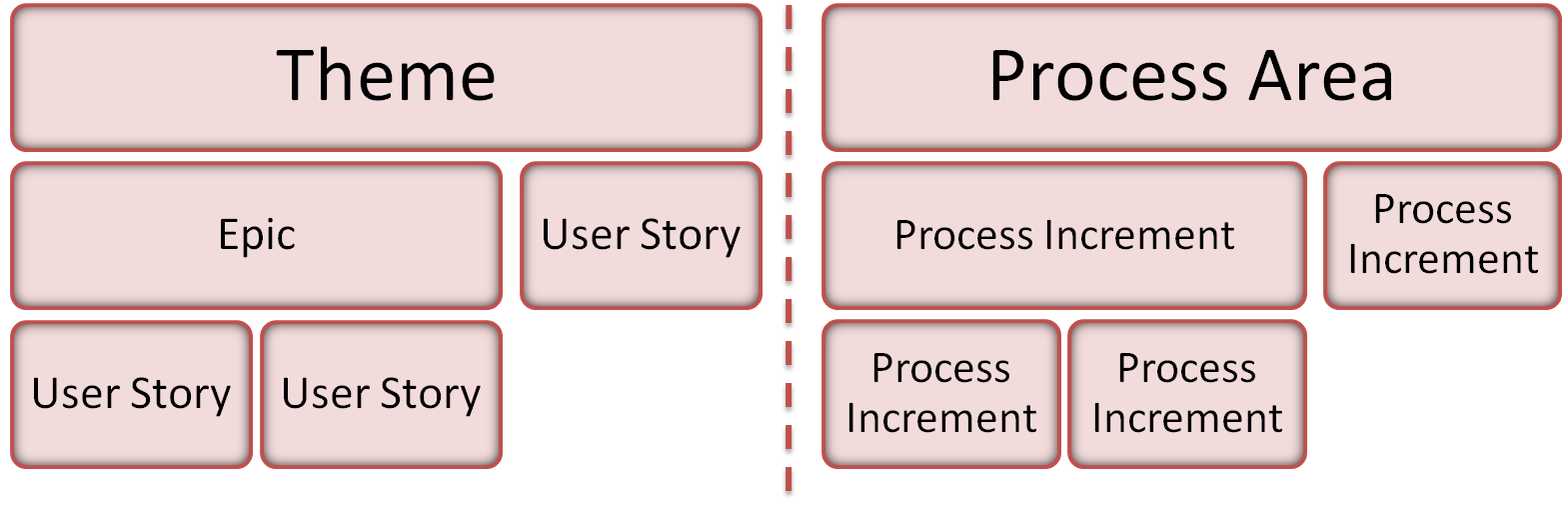
The concept of  Process Increment  in software process improvement (SPI) projects is almost identical to user stories in Agile development projects, as appears in the next diagram:

Process Increments
Process Increments mapping to Themes, Epics, and User stories

Furthermore, the process increments are estimated in points, and have very well defined 'Done' definition. They can even be written on index cards!

Also, the whole project is planned in releases and iterations, and tracked using burn charts. In short, process increments is about running process improvement projects as typical agile projects. 

We found that this approach has excellent results, including:
  • Better project visibility
  • Faster adoption of Agile practices
  • Faster improvement velocity in general
  • Very high team morale!
If you would like to read more about the results of the study, this is the link to the paper at the IEEE Xplore digital library.

Also, you may download the paper for free at the Agile Alliance website. You may also download the presentation and watch me presenting it live at the Agile conference 2011 at Salt Lake City, Utah.

Thursday, May 12, 2011

I'm presenting at the Agile Conference 2011

I'm presenting at the Aile Conference 2011, next August, in Salt Lake City, Utah.

This is an interesting experience for me, as it is the first paper, and the first conference participation. It happened to be the best Agile conference in the world.

My paper is titled: "Process Increments: An Agile Approach to Software Process Improvement". You can browse the abstract and the conference proposal at this link.

See you there inshaAllah!

Monday, April 25, 2011

Motivating teams to pilot Agile projects

This is an excellent advice by Gerald Weinberg, in this interview. The idea is that when doing organizational change, we need some projects to pilot changes before applying then to the rest of the organization. If projects are selected by management, the project team will view it as an assignment and may not cooperate very well. This is a problem that we need to handle when working with Agile adoption projects.

Weinberg suggests an excellent technique that he used many times, and had excellent results. He builds upon the innate developers' attraction to new ideas, technologies, frameworks, etc. The technique is to announces that if any team wants to become a pilot, they have to defend why they deserve it!

Simple and effective. He says that teams argued that instead of having one or two pilots, they all want equal opportunity of becoming pilots. Far beyond what a consultant would dream of!

Patterns of Agile Adoption Failure

Many teams are trying Agile methods, or rather techniques. Many of them fail, and suffer from this failure, usually because the failure induces resistance in the rest of the organization, and makes later attempts to Agile adoption much more difficult.

The following are four patterns of immature Agile implementations, where team concentrate on some superficial agile techniques without really embracing Agile values and principles:
  • Usually team starts with stand-up meetings, and it fails, because it simply hurts their legs for standing 1-2 hours daily! Moreover, the meetings are boring, and take a lot of time discussing issues. The team feels that this "Agile" thing is naive and wastes their time.
  • Teams do sprints:
    1. Either one complete sprint for every waterfall phase. That is a sprint for analysis, another for design, another for development, and a final one for testing. So, it simply becomes sprintfall rather than waterfall !
    2. Or one sprint for every big requirement or group of requirements. The problem with this approach is that no feedback loop exists. In other words, they have split a big waterfall project into smaller ones. Just bigger management overheads
  • Teams use sticky notes and decorate the walls with whatever they do, even with requirements in a typical waterfall project. After a while, they lose interest in updating the board notes. Because every step take a lot of time (2-3-weeks), and they cannot see any value of maintaining two databases of requirements and tasks (board and electronic)
  • Team does everything just right, but do not take feedback from customers. Somehow better, but still waterfall in the large. Teams iterate to get feedback and to adjust their development effort along the way. If they do not get feedback, the value of iterating is not realized
These are some failure patterns, there are many others; if you have any experience with this, please let us know about it :)